 Malaysia
 Singapore
 Thailand

If you’re one of those folks who spends time doomscrolling through Instagram, chances are you’ve come across Mibbedong’s tomato salmon ‘noodles’ from Seoul. Raw salmon is sliced into long strips to mimic the shape of noodles. Curious if it lived up to the hype, we all made a beeline for it when our bossman brought the whole company to Korea for our annual retreat. After savouring it, all I could say was, “OH MY GOODNESS GRACIOUS!” — the 30-minute subway journey was worth it.
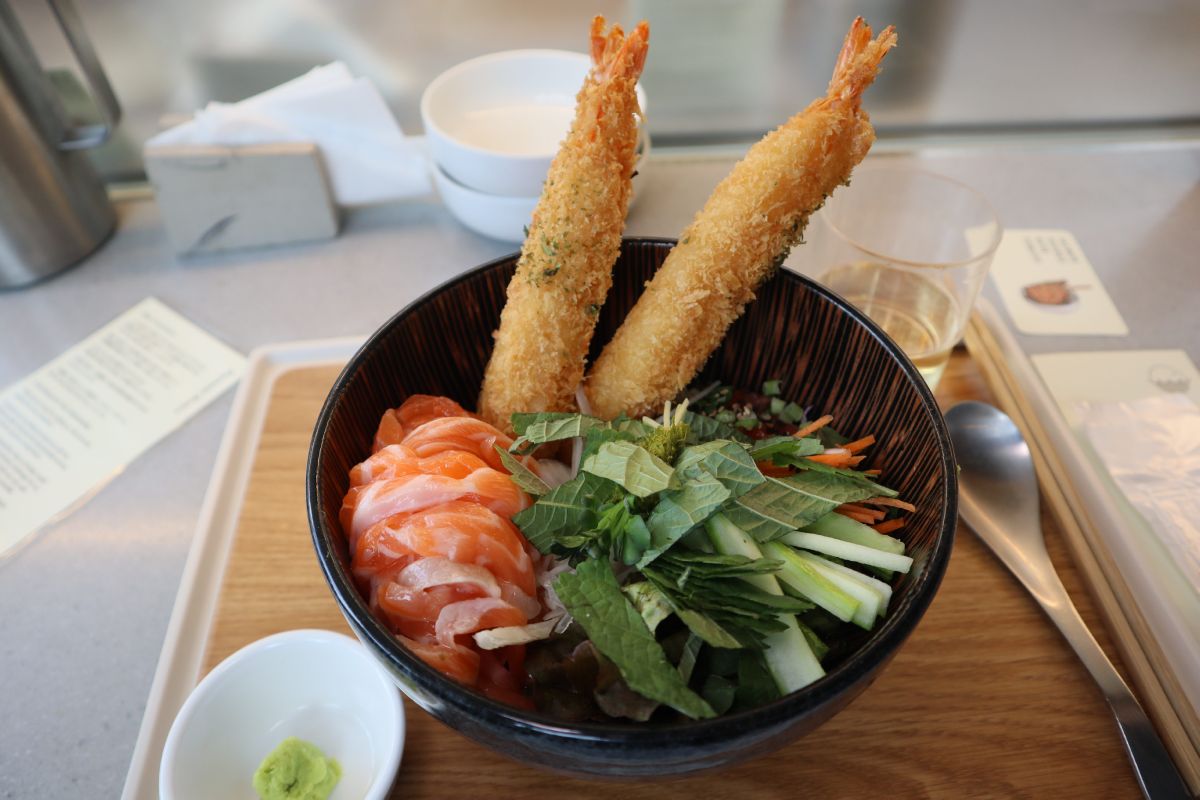
Cold, spicy, and refreshingly tangy, the bowl of Salmon-Noodle with Tomato cost ₩22,000 (around S$19.50).
My friends have been telling me that there are loads of online recipes that teach you how to recreate this dish from scratch. Sometimes, I love challenging myself and have decided to rely on my past chef experience, palate, and gut feeling instead to make my own version. Since this dish is mostly served cold (except the breaded prawns), there won’t be much cooking needed.
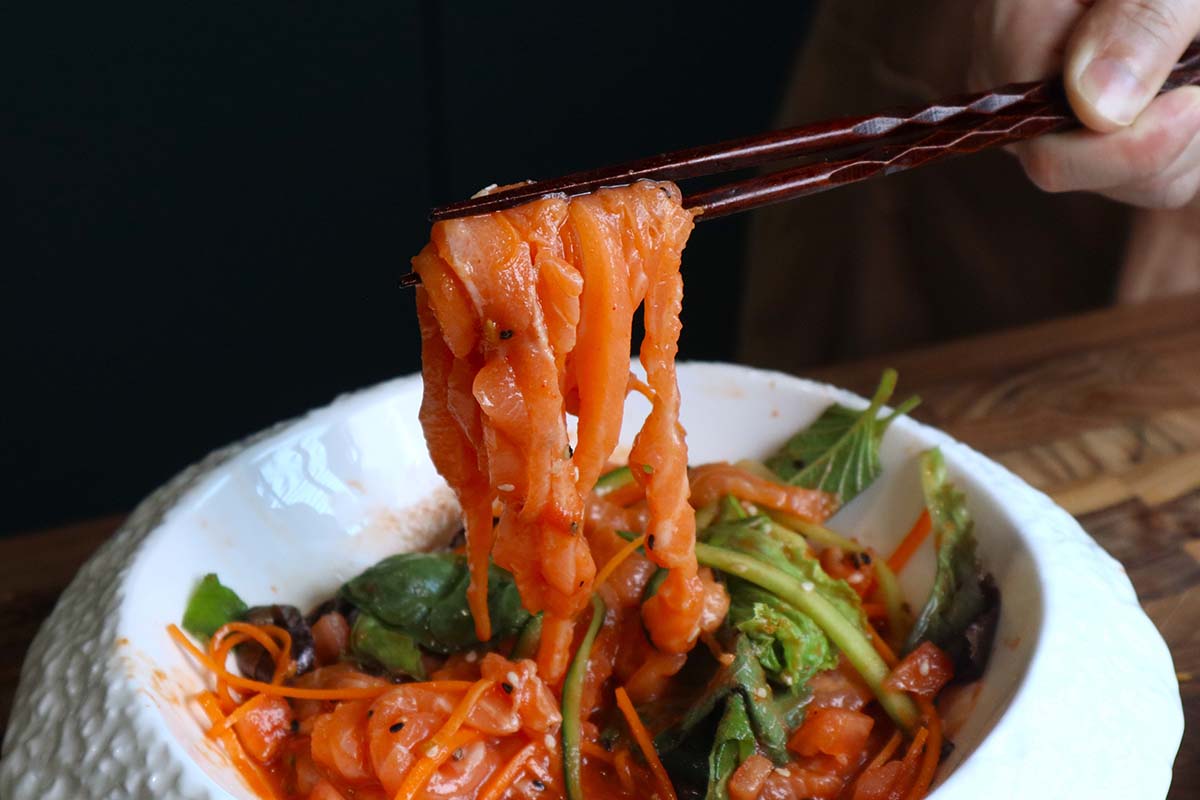
You’ll just require a small food processor/blender, a small pot of boiling water, and a small pot of frying oil. Let’s get started!
Ingredients, quantity and cost
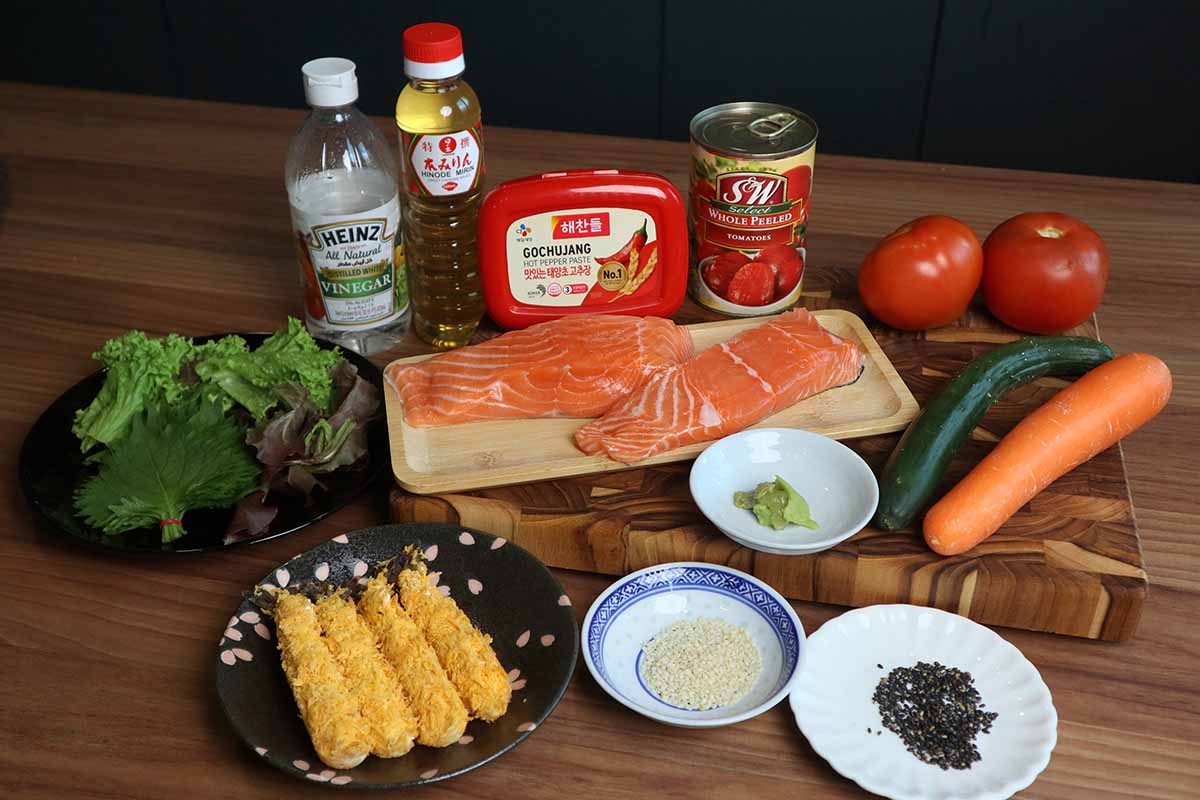
| Stall | Item | Quantity Needed | Cost |
|---|---|---|---|
| Song Fish | Sashimi-grade salmon | 2 small slabs | S$17.05 |
| Song Fish | Breaded prawn (pack of 10) | 4 pieces | S$4.30 |
| FairPrice | Whole peeled tomatoes | 1 can | S$2.98 |
| FairPrice | Mixed lettuce (salad pack) | A handful | S$4.75 |
| FairPrice | Mirin | 4 tbsp | S$3.77 |
| FairPrice | Fresh tomato | 1 | S$0.96 |
| FairPrice | Japanese cucumber | Half | S$1.80 |
| FairPrice | Black sesame | A handful | S$1.53 |
| FairPrice | Carrot | 1 | S$0.29 |
| FairPrice | Gochujang (hot pepper paste) | 1.5 tbsp | S$6.01 |
| Don Don Donki | Perilla leaves | 8 | $1.90 |
| From my house | White vinegar | 3 tbsp | N/A |
| From my house | Wasabi (from past sushi packs) | 3 sachets | N/A |
| From my house | Lime | Half | N/A |
2 small slabs of salmon yield about 2 portions, depending on the size of your strips and your, ahem, appetite. The total estimated cost to make 2 portions was S$45.34, just slightly more expensive than the actual bowl at Mibbedong. However, if you decide to make it again after a few weeks, you can reuse the gochujang, breaded prawn, and mirin, making it more cost-efficient.
Bonus ingredient: Lime
We added the lime in as we felt that our finished dish lacked a little citrus boost. Simply squeeze in the juice of half a lime at Step 4.
Steps
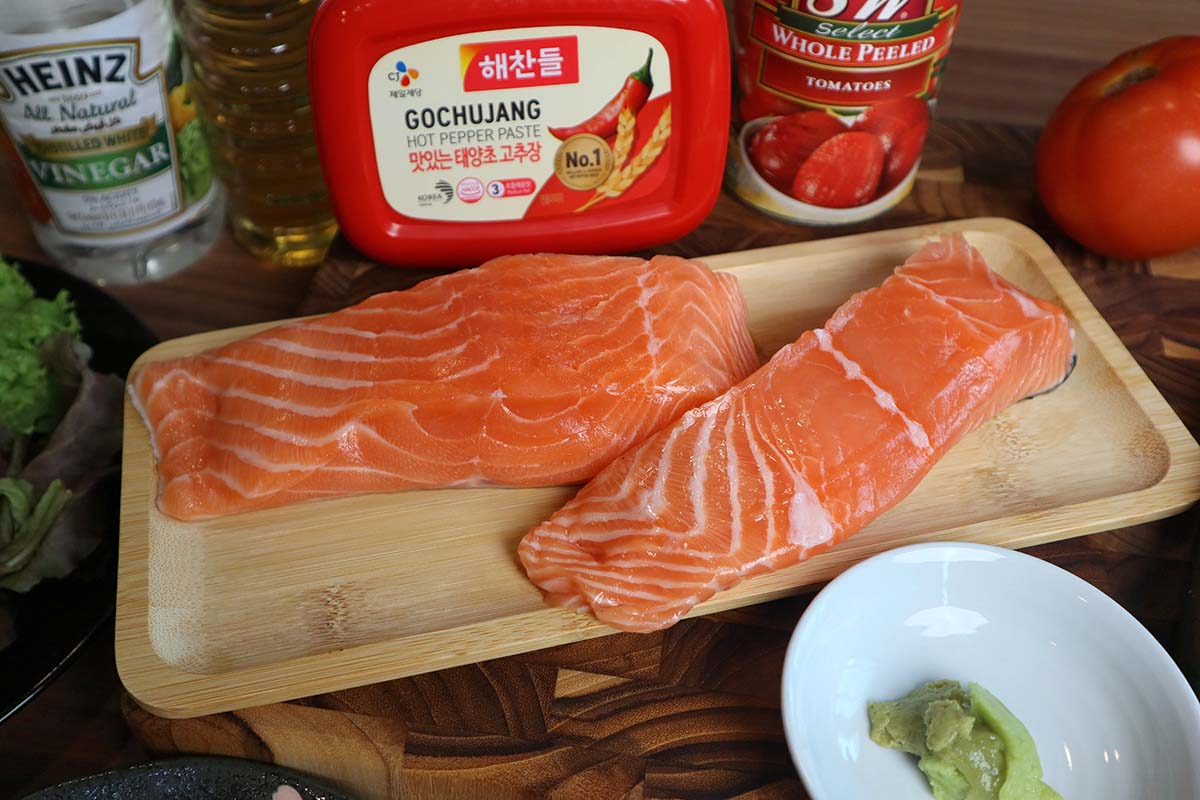
As this dish is eaten raw and only relies on the sauces, I must emphasise the importance of purchasing only sashimi-grade salmon. The slabs of salmon sold on the supermarket shelves are only suitable for cooking and are not advisable to be eaten raw. That’s unless you don’t mind running to the toilet frequently — please don’t take the risk.
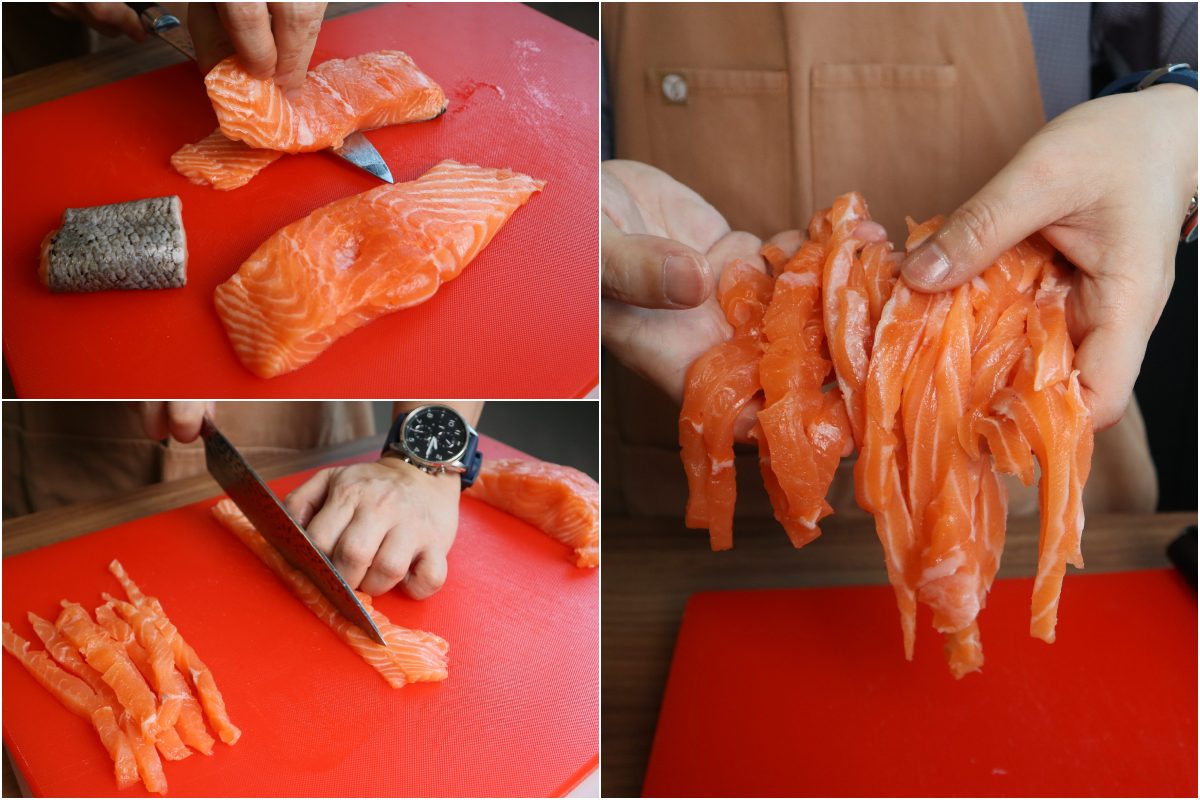
1) With a sharp knife, cut away the skin and try your best to slice them thinly lengthwise. Next, cut them into thin, noodle-like strips.
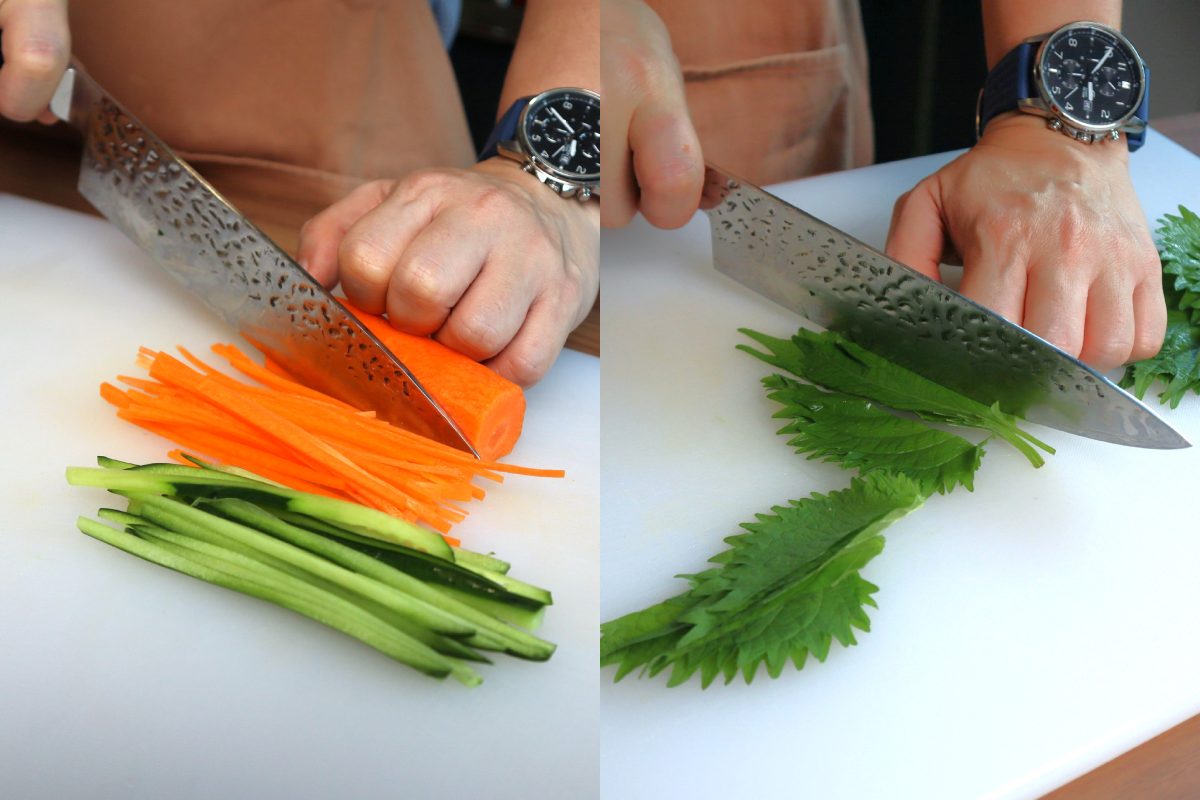
2) Slice the Japanese cucumber (without the seeds) and carrot into thin, julienne-like strips. For the perilla leaves, cut off the stem below before cutting or tearing them up into big pieces. Repeat the process for the mixed lettuce.
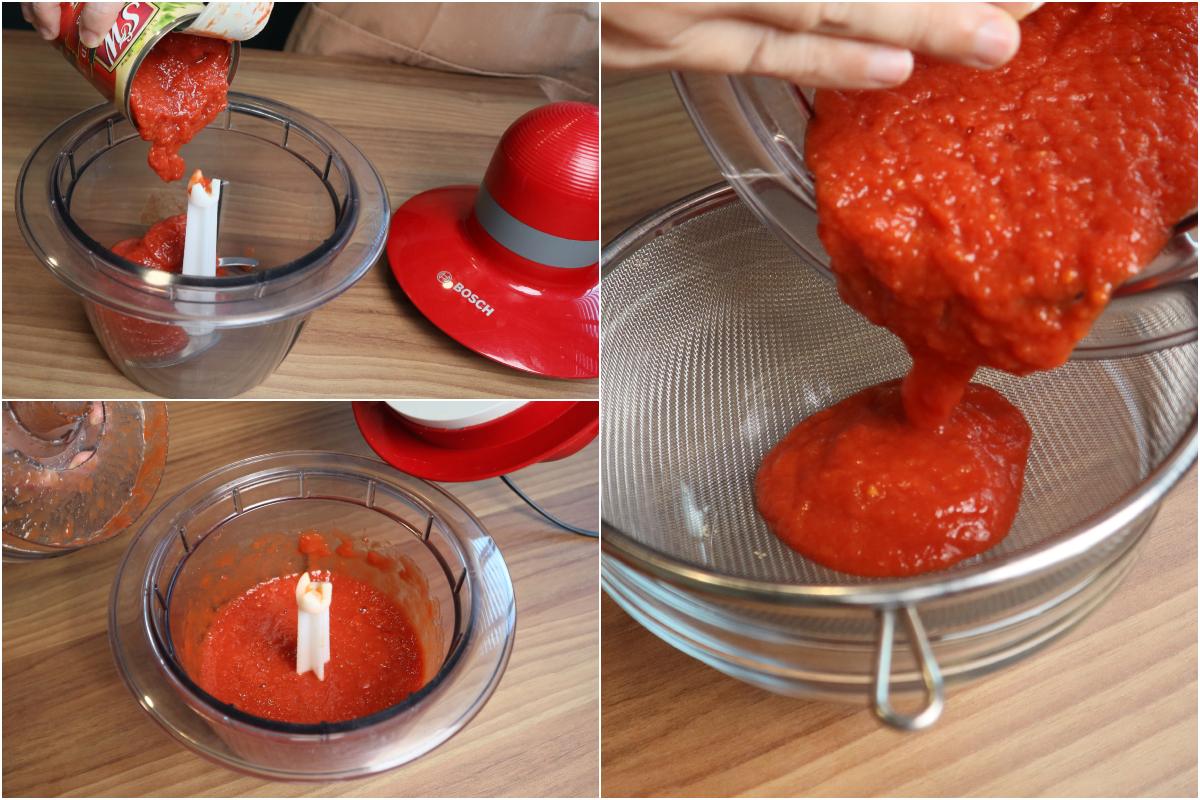
3) Empty the can of whole peeled tomatoes into a food processor and blend till its fine. After that, pour the contents into a sieve and use a spoon to filter out the mixture to get a smooth liquid underneath.
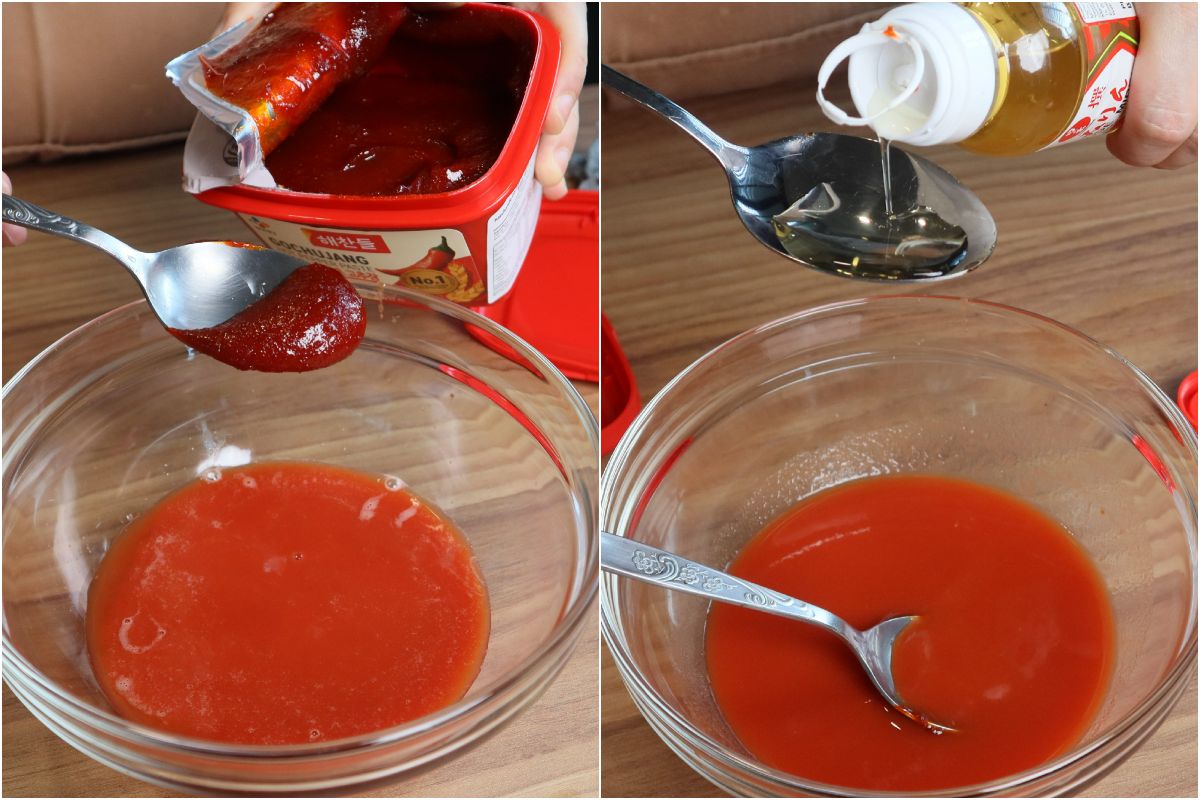
4) Add the gochujang, mirin, and white vinegar into the strained tomato mixture, then whisk everything well together. Here’s also where the bonus ingredient comes into play.
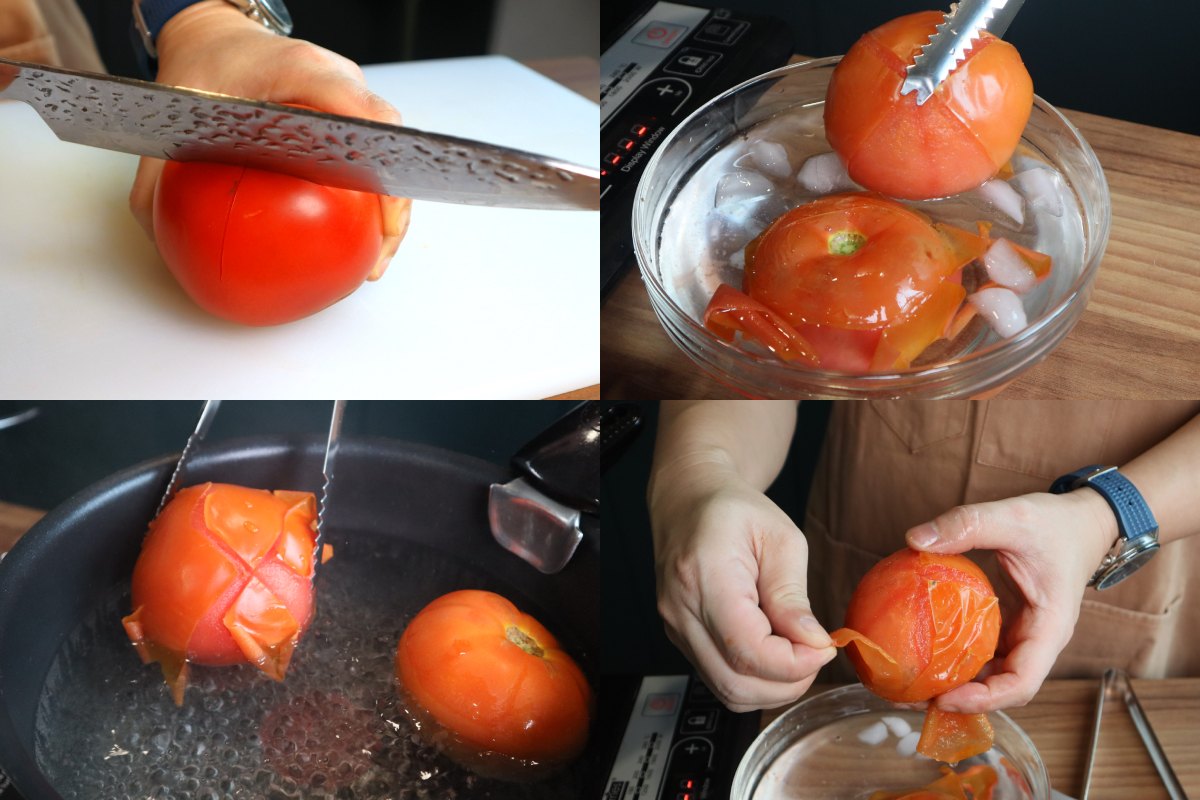
5) For the tomatoes, just ignore the picture above and use one instead (we had too much). Make a small cross incision with your knife at the base of the tomato. Once the pot of water boils, throw in the tomato for about a minute and immediately transfer it to a bowl of ice water. Then, you should be able to peel the skin off the tomato with ease.
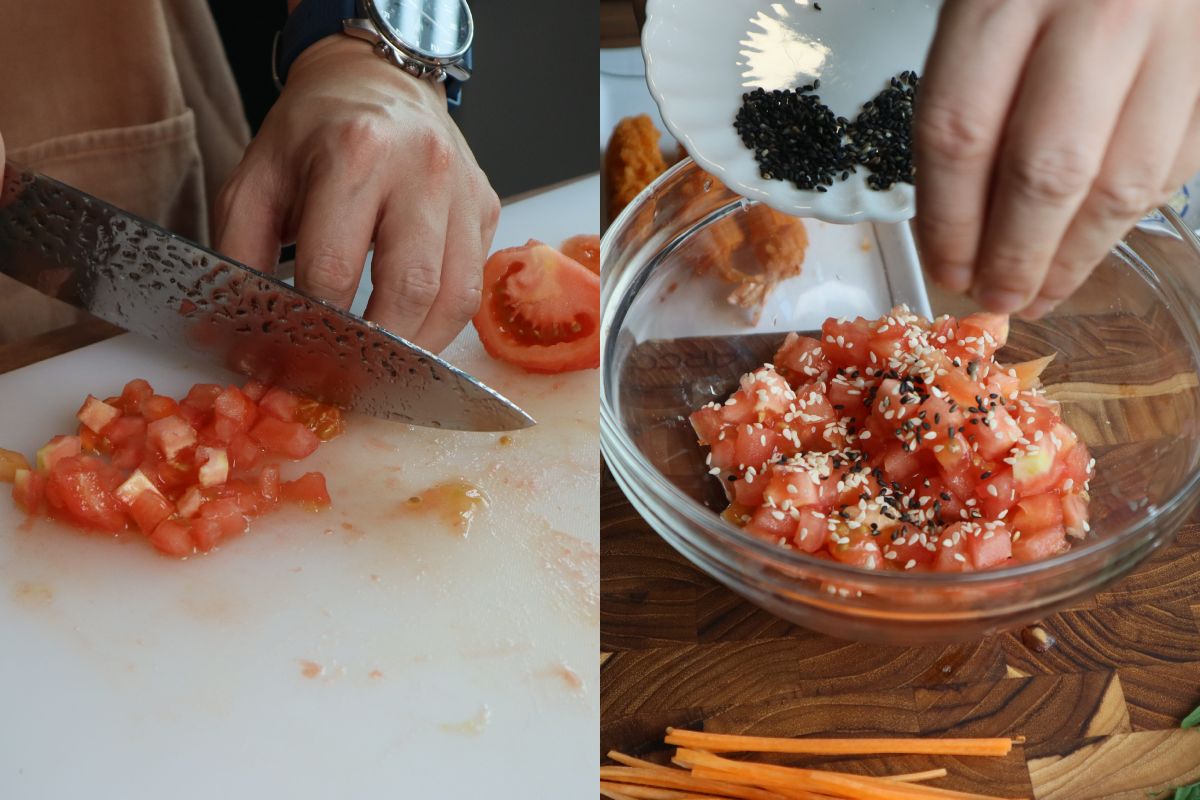
6) Cut the tomato (including the seeds) into small cubes . Sprinkle in some salt, pepper, and black sesame seeds. We also added some white sesame seeds for extra visual appeal, though that’s entirely optional and won’t affect the overall flavour. We just had some lying around!
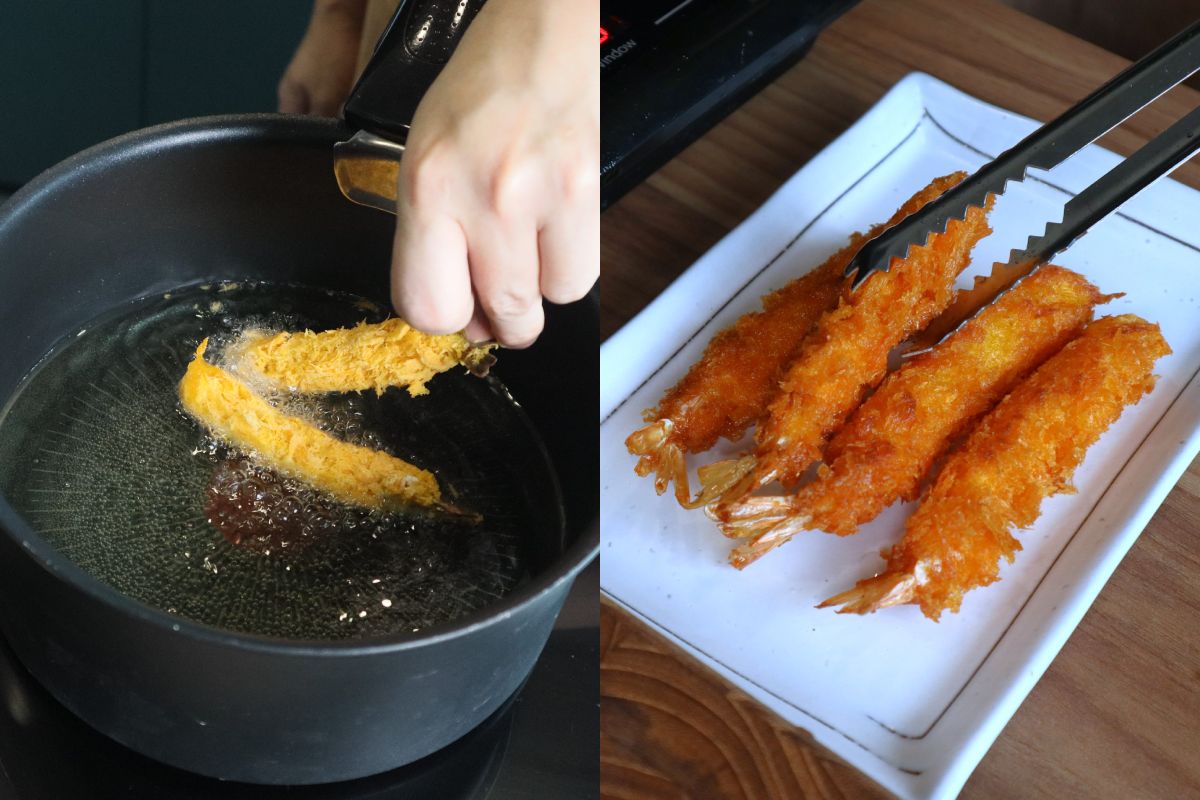
7) Heat enough oil in a small pot to deep-fry the breaded prawns until they’re golden brown and crispy. If you own an air fryer, by all means, use it — I’m just a little old-school. Since the 2 fried prawns at Mibbedong were bigger, we used 4 pieces to make up for its smaller size.
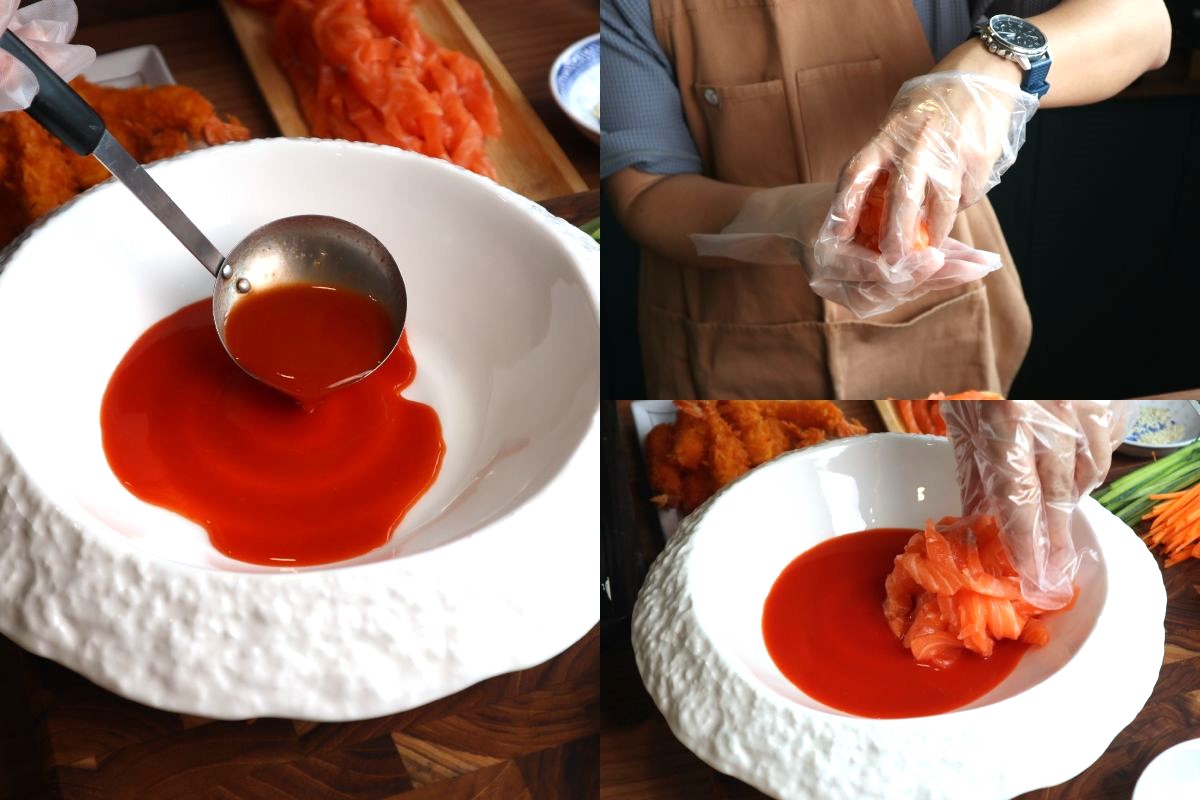
8) Pour about 1.5 ladles of tomato mixture into the base of the bowl. I then shaped the strips of salmon into a big orb and placed it at the side.
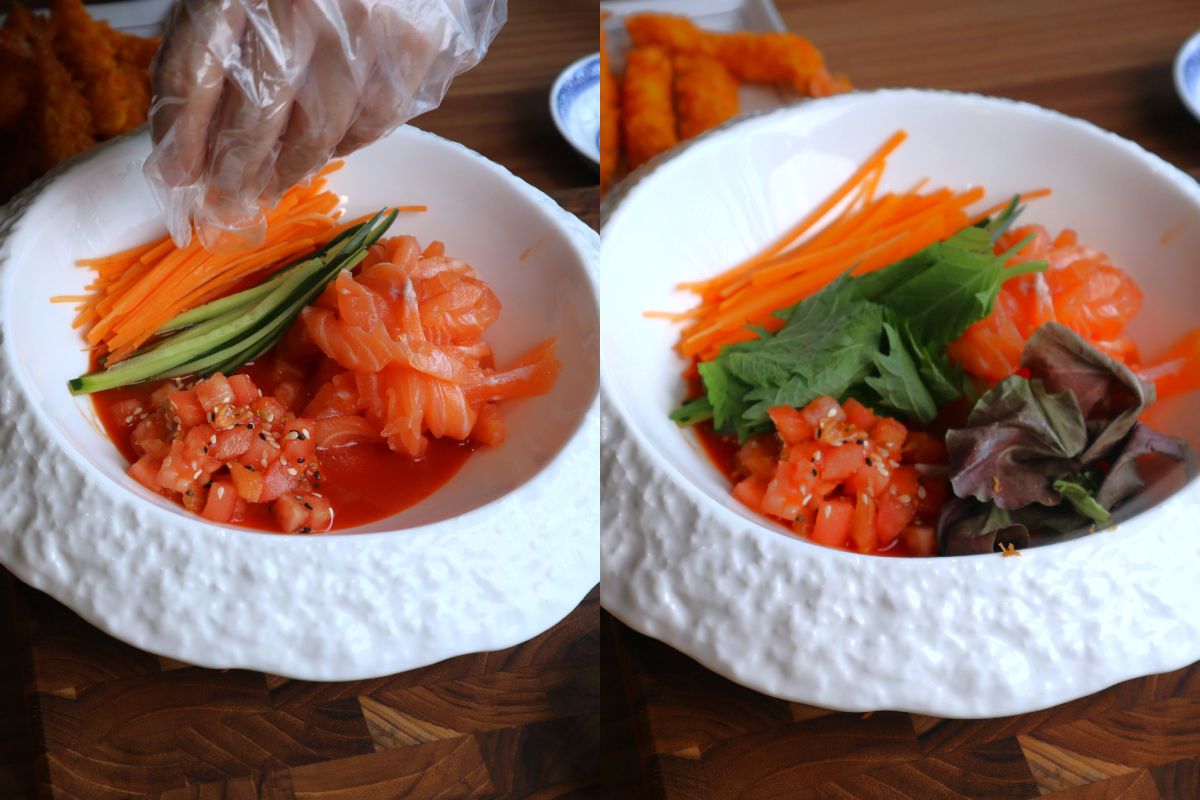
9) Next, add in the cucumber and carrot strips, tomato cubes, perilla leaves, and torn lettuce.
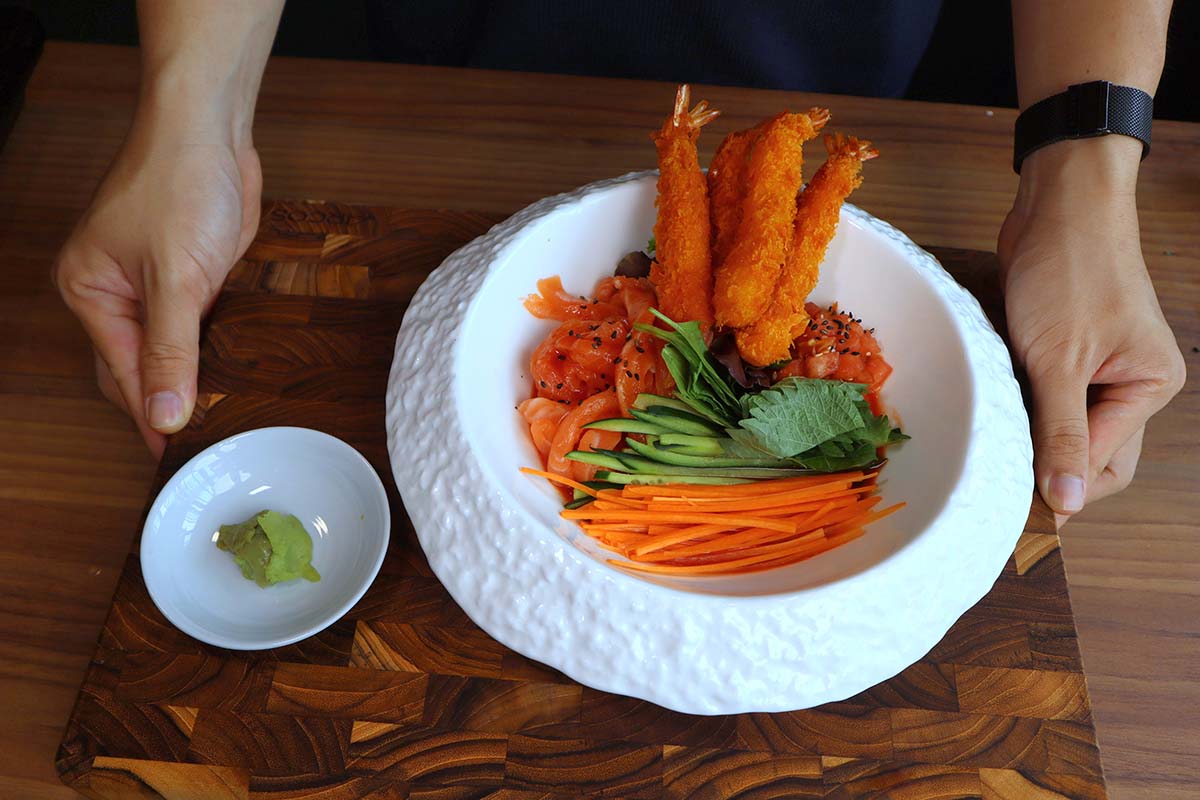
10) Add the breaded prawns as a finishing touch, and serve it with a side dish of wasabi.
Verdict
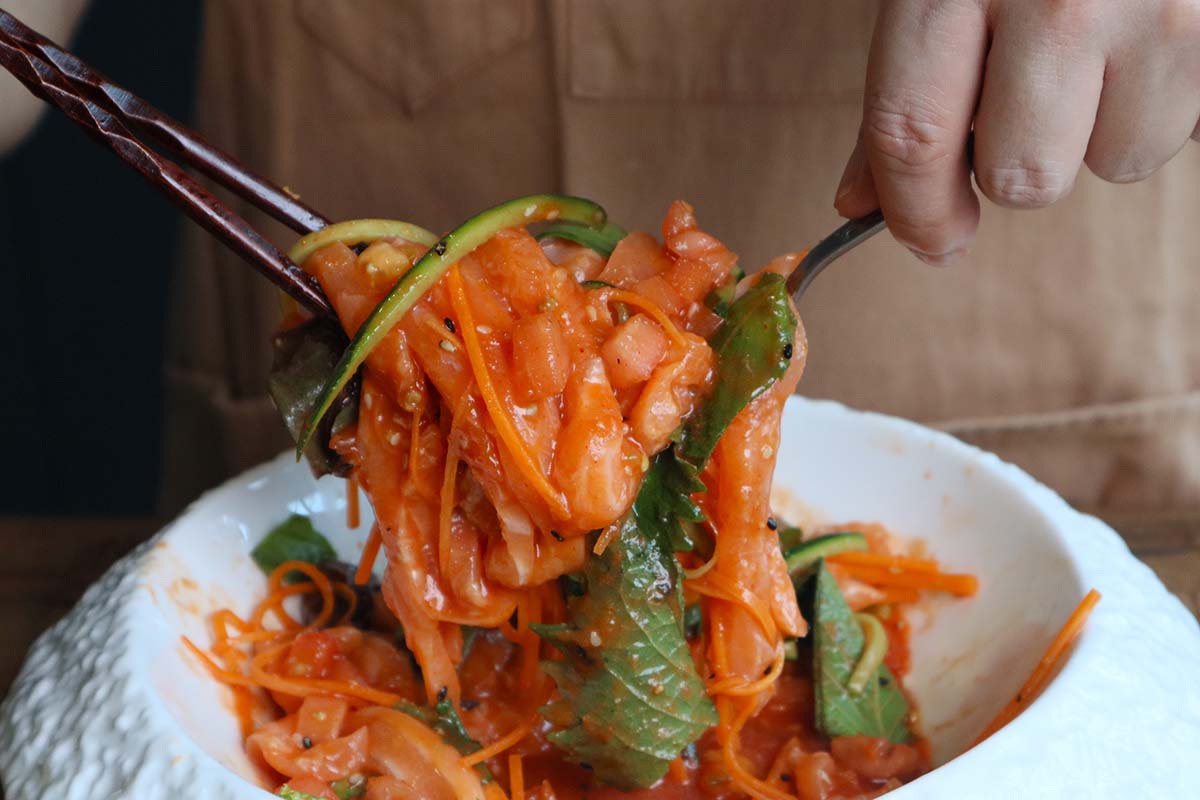
With the modified recipe of adding the lime, your rendition should be a step above ours. Our own version of salmon noodles was spicy enough with the added wasabi and gochujang. Even though our sauce tasted zingy enough before mixing everything in, the flavour somehow became a little weaker when we ate everything together. So, if your sauce is slightly too sour, sweet and spicy, you’re on the right track.
Once everything is mixed together, the bold flavours mellow into a harmonious balance. The perilla leaves add a distinctive, liquorice-like note that takes the dish up a notch and keeps you coming back for more. It’s light, refreshing and perfect for a hot, sunny day — which, let’s be honest, is pretty much every day in Singapore. The fried prawns by the side are the perfect accompaniments to this dish. Go give it a try and tell me how it went.
People also read:
Can you make the popular Xiang Xiang Hunan Cuisine’s Hunan stir-fried pork at home?
Is there a Japanese kopitiam stall in Singapore that’s worth a try?