 Malaysia
 Singapore
 Thailand

Between 3 Jul 2023, when Singapore’s 5-cent plastic bag charge scheme started, and Mar 2025, there was a 70 to 80 percent drop in the number of plastic bags issued. If the government was looking to change consumer habits, those 21 months showed that an amount as small as S$0.05 can be an effective proverbial stick.
Has the charge changed your attitude towards the environment, though? I know I fit right into the “70 to 80 percent reduction” statistic in terms of how many fewer plastic bags I have opted for since Jul 2023; still, I predict that if the government removed the charge, I — and most other Singaporeans — would go right back to our old habits.

So, what has the scheme achieved, aside from taking millions from the population and transferring it to multimillion-dollar supermarket chains?
Where does the money go?
My first concern regarding the scheme — which should be the concern of any citizen — is where our money is going.
In the 18 months to the end of Dec 2024, supermarkets had collected over S$9 million in revenue from mandatory plastic bag charges. I initially assumed that all revenue, or at least the bulk of it, is directed to the government to finance green initiatives. It isn’t.
The supermarkets keep every cent to use at their discretion.
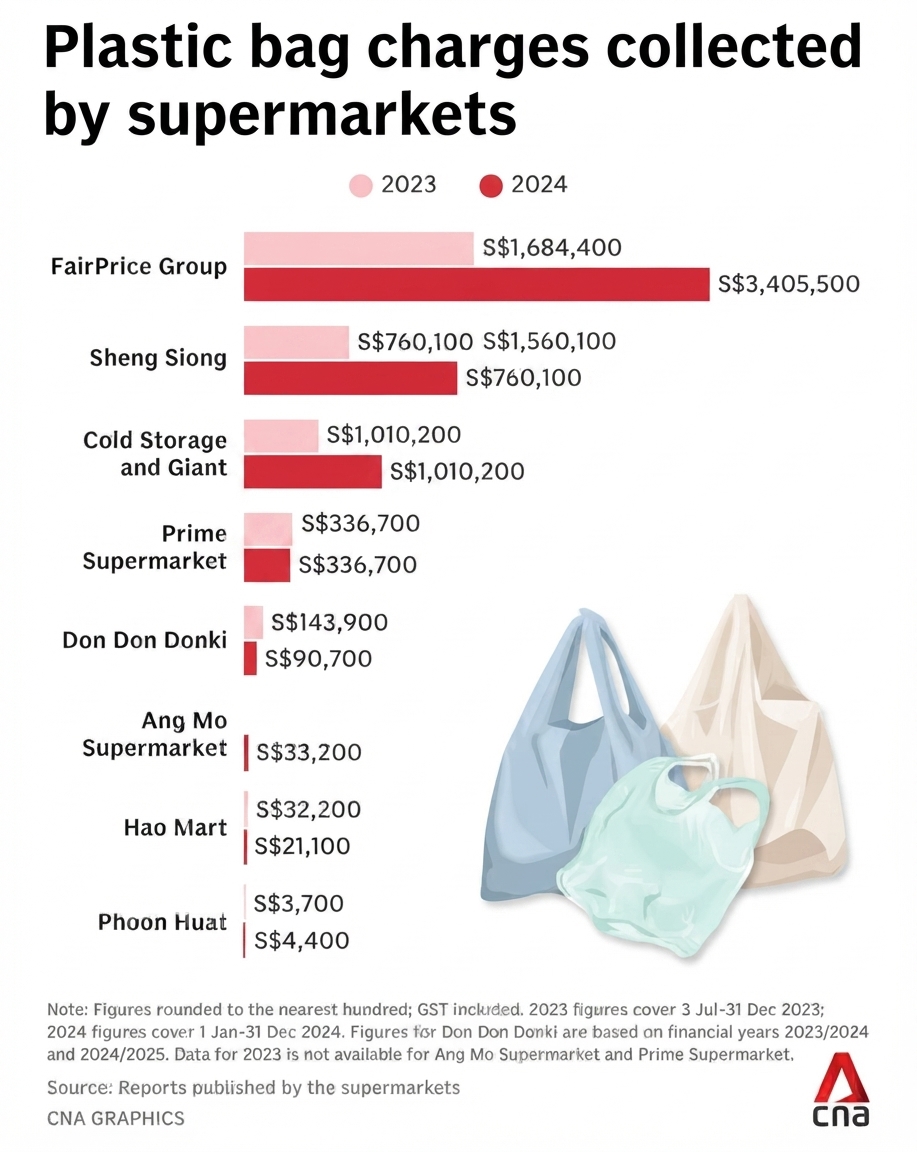
To their credit, most of the collected revenue has been rerouted to charitable causes. These include:
- FairPrice Foundation: Received approximately half of FairPrice’s proceeds to fund health, social welfare and nutrition programs.
- President’s Challenge: Almost all of Sheng Siong’s collected fees were donated to this cause.
- Green groups: Some proceeds went to organisations such as WWF-Singapore and the Garden City Fund.
That is commendable, isn’t it? Yes and no.
Of course we should commend any business that chooses to give back to the community and to the needy. However, I question the logic of having members of the general public, who have their daily financial struggles, fund the CSR of giant corporations.
Why are we paying from our pockets so some CEO can play the magnanimous philanthropist?
Why not zero plastic bags?
The other detail that makes me question the scheme is that it only goes halfway. It is estimated that in 2025, with the scheme in full swing, Singaporean shoppers purchased between 120 million and 130 million plastic shopping bags. Why give people the pay-to-pollute option if we are concerned about the environmental impact of plastic bags?
I was surprised to learn that one of the chief reasons against a 100% ban on plastic bags is that most Singaporean homes reuse plastic bags as bin liners.

Apartment blocks, be it HDB or private condos, employ individual or communal rubbish chutes for waste disposal; a complete ban would likely encourage residents to dispose of waste loosely, which would have cleanliness and hygiene consequences. The compromise is to give shoppers the option to buy plastic bags, knowing that the nominal cost will greatly reduce the proportion of shoppers who opt for one.
On the surface, that makes complete sense. However, I took a deeper dive and the logic seemed to break down.
FairPrice itself sells multipurpose 10-litre plastic bags that can be used as bin liners for S$1.82 for a 60-pack. That comes to just 3 cents per bag, 40 percent cheaper than the mandatory 5 cents they charge you at the checkout. Why, I never!
Does it make sense that we pay 5 cents to a supermarket for a plastic bag, ostensibly for its future use as a garbage container, when the same supermarket already sells purpose-made garbage bags at a significantly lower price?
From pricing to prohibition?
I say let Singaporeans keep the millions of dollars the plastic bag scheme will net, to use or donate as they wish and not be forced to fork it out to any company.
A 5-cent plastic bag charge (or 10-cent bottle deposit, for that matter) assumes that the consumer is the primary problem and that the right price can fix habits. Having run for over 3 years now, the scheme has shown that convenience trumps pocket change but attitudes remain largely unchanged. It is environmentalism as a luxury, where paying a few extra cents gives you the green light to pollute.
If governments genuinely want to eliminate single-use waste, they have to move past the pay-to-pollute comfort zone. True systemic change doesn’t come from charging a fee at the checkout counter but from ensuring the polluting material never reaches the shelf at all. Hey, if we can do it for chewing gum…
People also read: