 Malaysia
 Singapore
 Thailand

Sibu is a landlocked city located on the West side of Sarawak, Malaysia. It embodies the region’s famous biodiversity by holding the moniker of ‘Swan City’, which comes from a local legend where swans flew across the city to signal the end of a great famine.
This legend is also the namesake of Swan City Noodle House, a noodle stall in Amoy Street Food Centre run by a Chinese woman hailing from Sibu.
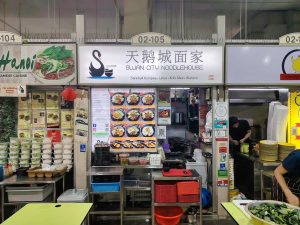
I honestly did not know what to expect, since I have never tasted any dishes from this part of Malaysia before. In fact, I did not even know Sibu existed before I did some research about the region’s history. Suffice it to say, this was going to be a journey of discovery for me.
What I tried at Swan City Noodle House
Swan City Noodle House features a small but focused variety of dishes from Sarawak, with the crowd favourites being their Kampua Noodles and Kolo Mee. They also offer snacks like Sibu Kompia and Bien Nuik, which is Sibu’s unique take on wantons.
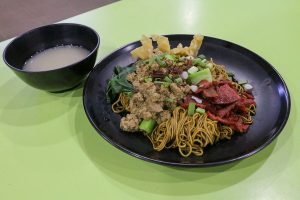
The first thing I ordered was their Kampua Noodles (S$5), which came in three variations: White, Black, and Mala (+S$0.50). I wanted to avoid numbing my taste buds, so I swore off the Mala. Upon asking the owner what the difference between White and Black noodles was, she told me that Black noodles are sweeter, so I went with that.
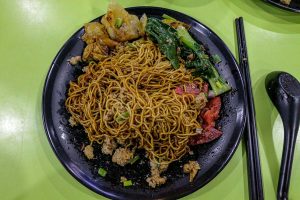
The noodles were quite difficult to toss, as they clumped together into a single mass. This is usually an indicator of the noodles being a bit dry, and it certainly felt that way as I clumsily lifted the entire blob of noodles. After a light splash of soup, the noodles finally separated into more manageable strands.
Perhaps the owner could serve her Kampua Noodles in a bowl, as some of this difficulty in tossing came from my fear of the noodles spilling everywhere.
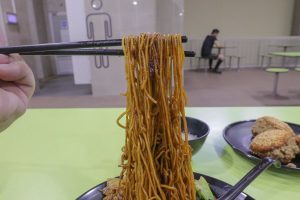
Kampua is often characterised by a seasoning of pork lard and a gentle dousing of soy sauce, and I could definitely taste that here. Slurping the noodles invoked a sense of nostalgia in me, despite never having visited Sarawak before.
The deep hue of the noodles suggested an overwhelming soy sauce flavour, but the sweetness was very mild. If anything, I think they could cut down on the pork lard, as the taste was a bit much for me.
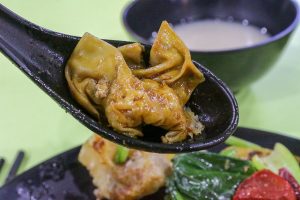
The dish came with 4 wantons — 2 fried and 2 boiled. The boiled wantons were hard to spot since they were buried under the noodles. I enjoyed the boiled wantons, despite the small size. They were slippery in my mouth, and the filling tasted like pork with a bit of pepper.
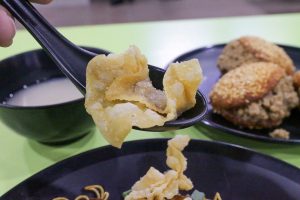
Unfortunately, the same could not be said of the fried wantons. The small size did it no favours as I could only taste the fried skin and none of the filling.
Tracy’s Sarawak Kitchen: Unique Eastern Malaysian dishes like money cai mee sua & tomato kway teow
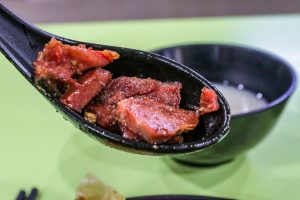
The char siew was a rather mixed bag. Some slices were chewy with a decent chunk of sweet meat, while other slices were soft like gelatine with no meat at all. It’s nothing too glaring, but something to look out for if you’re a stickler for consistency.
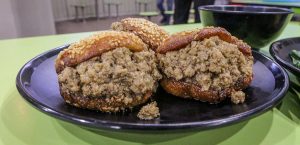
I also tried their Sibu Kompia (S$5.80 for 3pcs). I do wonder why they cost S$0.80 more than a full plate of noodles, but that could be attributed to prep time, as the owner told me that the kompias take around 10 minutes to prepare.
For the uninitiated, kompia is another name for Guang Bing, a type of bagel that originates from the Fuzhou province in China. Sibu has also been called ‘New Fuzhou’ for the number of Chinese from Fuzhou who immigrated to the city.
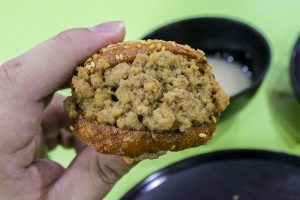
My first reaction to the kompias was a vocalised “oh my god, it’s so oily”, as the buns were deep fried to a golden crisp. I was actually quite afraid to grab them with my hands, as I knew I’d have a hard time washing the oil off.
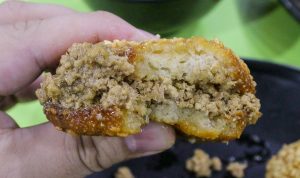
The crunch was otherworldly, like biting into an umami-flavoured bread cracker. The oil from the bun and juices from the minced meat mixed and dripped like a waterfall with every bite. It was a messy delight that has become my next guilty pleasure snack.
I don’t know if this is the traditional way to serve kompia, as most photos I’ve seen online depict it with much less oil.
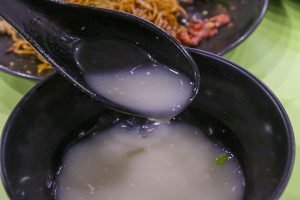
Thankfully, Swan City Noodle House has free-flow soup that’ll wash away the jelak feeling you’ll inevitably encounter after eating the kompias.
Final thoughts
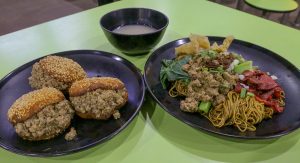
If this is how everything from Sarawak tastes, then consider me hooked. Whether you’re a curious Singaporean or a Malaysian seeking a taste of home, Swan City Noodle House hits the nail on simple yet effective nostalgic flavour. They just need to iron out a few things — like their oily kompias — before they can really soar.
Order Delivery: foodpanda
People also read:
Which Sarawak kolo mee stall at Haig Road Market & food centre did we prefer?
Is there any yong tau foo stall at Chinatown Complex that serves Malaysian-style noodles?